
AMD-powered supercomputer breaks exascale barrier, fastest in the worldLeigh Mc Gowranon May 31, 2022 at 07:13 Silicon RepublicSilicon Republic
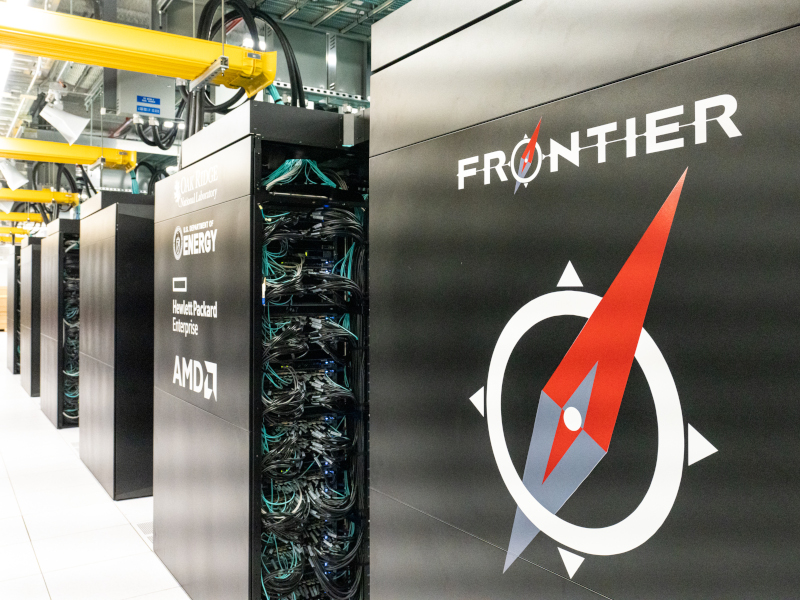
The biannual Top 500 supercomputer ranking has put a US machine called Frontier at the top of the list, naming it the most powerful supercomputer to ever exist and the first officially recognised exascale machine.
In a HPL benchmark test, the Frontier supercomputer at the US Department of Energy’s Oak Ridge National Laboratory (ORNL) gave a performance of 1.1 exaflops using more than 8.7m cores, surpassing the threshold of a quintillion calculations per second.
Based on the latest HPE Cray EX architecture and equipped with AMD EPYC 64C 2GHz processors, Frontier also hit the top spot on the Green500 list, which rates the energy use and efficiency of supercomputers. Frontier earned a performance of 62.68 gigaflops per watt.
Frontier’s mixed-precision computing performance was roughly 6.88 exaflops, or more than 6.8 quintillion flops per second. This test measures speeds in computing formats typically used by the machine-learning methods that drive advances in artificial intelligence.
To explain the power of an exascale supercomputer, ORNL said that if each person on earth completed one calculation every second, it would still take more than four years to do what an exascale computer can do in one second.
“Frontier is ushering in a new era of exascale computing to solve the world’s biggest scientific challenges,” ORNL director Thomas Zacharia said. “This milestone offers just a preview of Frontier’s unmatched capability as a tool for scientific discovery.”
Frontier overtook the previous leader called Fugaku which earned the top spot in 2020. Based in the city of Kobe in Japan and co-developed by Riken and Fujitsu, its 7.6m cores allowed it to achieve 442 petaflops. Fugaku’s performance put it three times ahead of the next highest spot on the list.
ORNL said the next steps for Frontier include continued testing and validation of the system. The machine is expected to achieve final acceptance and early science access later this year and full science access at the beginning of 2023.
ORNL said detailed simulations relied on by traditional HPC users to model phenomena such as cancer cells, supernovas, Covid-19 or the atomic structure of elements require 64-bit precision, a computationally demanding form of computing accuracy.
Speaking to SiliconRepublic.com, ICHEC director Prof JC Desplat said HPC has become a fundamental part of research and scientific advancement across all disciplines, particularly in areas such as climate informatics, digital twins of Earth systems, healthcare and medicine, and material sciences.
10 things you need to know direct to your inbox every weekday. Sign up for the Daily Brief, Silicon Republic’s digest of essential sci-tech news.
The post AMD-powered supercomputer breaks exascale barrier, fastest in the world appeared first on Silicon Republic.